

A growing dispute between Donald Trump and CNN over a controversial report on Iran’s claimed “victory” has triggered wider scrutiny about media sourcing, misinformation, and the unexpected mention of Nigeria in a high-stakes geopolitical narrative.
The controversy unfolded shortly after the announcement of a temporary ceasefire between the United States and Iran, a development that had already drawn global attention due to its potential impact on regional stability and global energy markets.
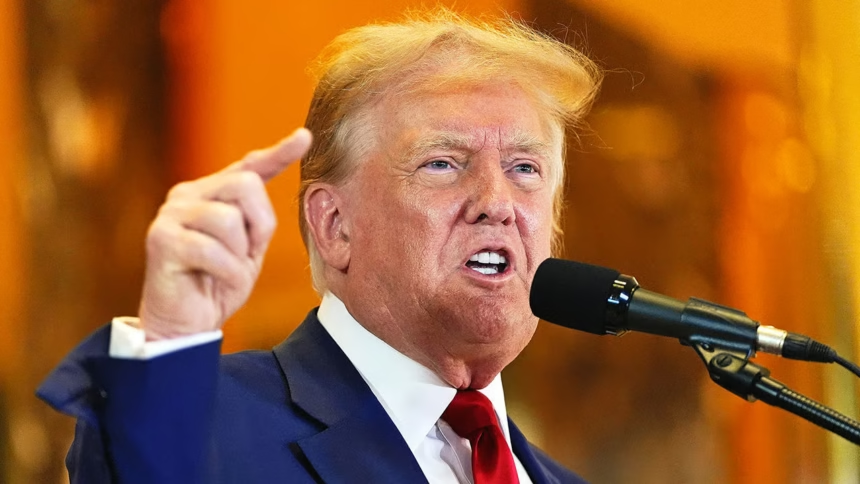
Rather than focusing solely on the truce, attention quickly shifted to conflicting claims about a statement attributed to Iranian authorities. Trump publicly rejected a version of the statement aired by CNN, alleging that it was fabricated and traced back to what he described as a “fake news site” originating from Nigeria. However, he did not provide verifiable evidence to support that claim, raising questions about the accuracy and intent behind the assertion.
CNN, on its part, maintained that its report was based on direct communication with Iranian officials and supported by multiple state-affiliated media channels within Iran. The network insisted that its editorial process followed established verification procedures, stating that the information reflected what was communicated by official sources at the time.
The disputed statement, attributed to Iran’s Supreme National Security Council, suggested that Tehran had secured a strategic advantage and compelled Washington into accepting elements of its negotiation framework. Trump dismissed this narrative, arguing that it did not align with what he described as Iran’s “official position” and calling for the report to be withdrawn.
Beyond the immediate disagreement, the episode has drawn attention to the broader issue of how sensitive geopolitical information is sourced, verified, and disseminated, especially during moments of heightened tension. Media analysts note that in fast-moving international conflicts, early reports often rely on fragmented or evolving information, increasing the risk of conflicting interpretations.
Trump escalated the situation further by suggesting that authorities were examining whether any legal violations had occurred in the publication of the report. His remarks added another layer to the controversy, shifting it from a media dispute to a potential regulatory or legal matter.
The mention of Nigeria has also sparked local and international curiosity. While Trump linked the origin of the disputed report to a Nigerian-based platform, no concrete evidence has been presented publicly to substantiate the claim. This has led to speculation about whether the reference was based on verified intelligence or part of a broader rhetorical strategy aimed at discrediting the report.
Industry observers point out that attributing misinformation to unnamed or unverified foreign sources without clear proof can complicate global media dynamics and potentially affect perceptions of digital platforms in emerging markets.
Supporting Trump’s position, Brendan Carr criticised the handling of the report, arguing that inaccurate reporting during sensitive national security moments could have serious consequences. His comments reflect ongoing debates in the United States about media accountability and the role of regulatory oversight.
Meanwhile, CNN has refused to retract its report, standing by its sources and reiterating that the information was obtained through credible channels. The network’s response underscores the tension between political authority and journalistic independence, particularly in situations where narratives from different sides of a conflict diverge sharply.
The dispute comes at a time when both Washington and Tehran are presenting their own versions of events following the ceasefire. While each side has framed the outcome in favourable terms, the agreement itself has been broadly viewed as a step toward de-escalation, especially given the strategic importance of the Strait of Hormuz to global oil supply routes.
Iran’s Foreign Minister, Abbas Araghchi, confirmed that safe passage through the strait would be maintained for a limited period as part of the arrangement, signalling a temporary easing of tensions.
From an investigative standpoint, the incident highlights the increasingly complex intersection of politics, media, and digital information flows. It raises key questions about how global news organisations verify sources in conflict situations, how political figures challenge or shape narratives, and how unverified claims about information origins can influence public perception.
For observers, the central issue is no longer just whether a statement was accurate, but how competing claims are validated in real time and what safeguards exist to prevent misinformation from escalating already fragile situations.